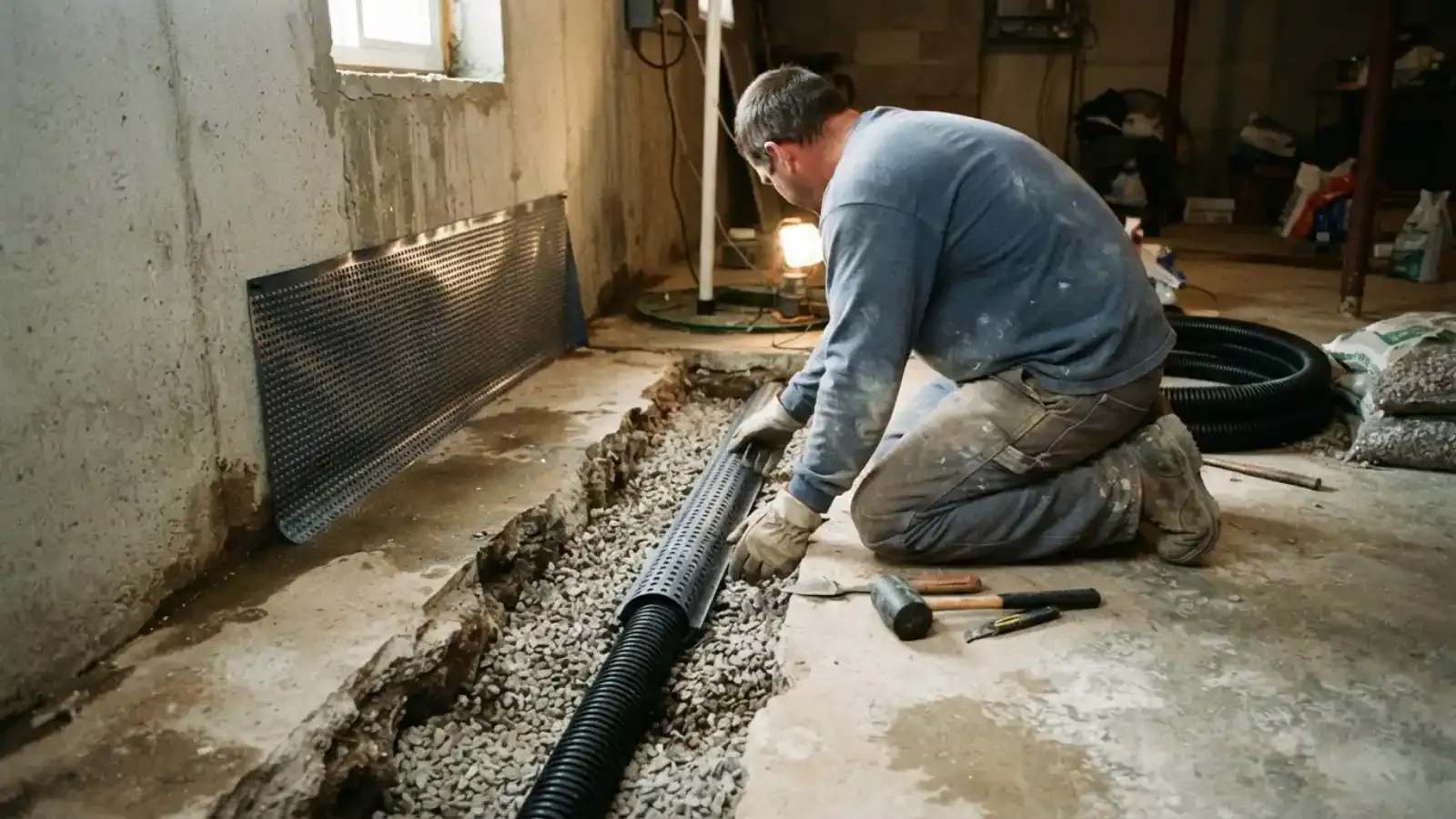
Why square footage is the wrong measure
A basement's floor area tells you little about the cost of keeping it dry. A small basement with one leaking wall needs one length of drain tile. A large basement with water at three walls needs more. Contractors measure the linear feet of wall that needs interior drainage, not the area of the floor.
So when you see a per-square-foot figure online, treat it as a rough marketing number. The real price depends on the length of drain tile, the number of sump pits and pumps, the access to the walls and how much finishing must be removed and restored.
That is why a serious quote starts with a visit, not a phone call.
What a waterproofing quote is built from
We give a clear price before work starts. Quotes usually break down like this.
Call for your real number: (651) 946-0134.
Fixes from cheapest to most involved
Start outside and work in.
| Fix | What it addresses | Typical order |
|---|---|---|
| Extend downspouts, fix grading | Surface water at the foundation | First. |
| Clean gutters and window wells | Overflow and pooling | First. |
| Seal individual cracks | A single leaking crack | Second. |
| Interior drain tile and sump | Seepage at the wall and floor joint | Third. |
| Backup pump | Outage risk | With the sump. |
| Exterior excavation and membrane | Major wall failures | Last, when needed. |
Local note: what to ask the city
Before you add or reroute a discharge line, call the City of Inver Grove Heights Permits and Inspections office at 651-450-2550 to ask about discharge rules. Do not tie sump or drain tile discharge into a sanitary sewer or septic system without confirmation. Parts of the city are not on city sewer.
If a floor drain is backing up with sewage and not clear water, that is not a waterproofing problem. It is a sewer problem. The city lists Utility Maintenance at 651-450-4309 and Dakota County Dispatch at 651-322-2323 after hours for sewer backups.
Questions to ask every contractor
Ask where the water enters and how they know. A contractor who has not looked at your basement cannot answer. Ask what part of the quote addresses the cause and what part is cosmetic.
Ask about the pump. What model, what capacity, what warranty. Ask about the discharge. Where does it go, and does it need a permit. Ask about the concrete. How wide is the cut, and who patches it. Ask about the schedule and the restoration.
Get at least two quotes with the same scope. Differences in price often come from differences in what is included, not from the work itself. See basement waterproofing for how we describe the job.
What waterproofing does not do
Interior drainage controls water that reaches the footing. It does not stop the water from entering the soil around the house. If the real problem is grading or gutters, fix those first and see whether the leak stops.
It does not fix humidity from a damp basement air. A dehumidifier does. It does not make a basement safe from a sewer backup. That is a different problem with different tools. See sump pump repair for pump issues.
Homes in Eagan and Rosemount vary a lot in age and construction, so no single price applies.
Keeping the finished space protected
If your basement is finished, ask the contractor how they plan to protect and restore it. Interior drain tile requires cutting a trench along the wall. Carpet, baseboard and the bottom of the drywall may be removed and replaced.
Ask whether the quote includes patching the concrete and whether the finish is paint-ready or only rough. A low price that leaves you with an unfinished trench is not a bargain.
Signs the quote is too good to be true
A very low price often leaves out something that matters. Watch for quotes that do not name the pump, that skip the discharge line, that offer no battery backup or that give no warranty in writing. Be wary of a contractor who will not look at the basement before quoting, or who pushes a full exterior excavation for a minor seep.
Ask how long the company has serviced the area under its current name, and ask for the license information a Minnesota plumbing or waterproofing contractor should be able to show. The state Department of Labor and Industry has a tool for checking a plumbing license, and you can use it before you sign.
Timing the project around the seasons
Interior drainage work is easiest when the ground is not frozen and the basement is dry enough to cut the floor cleanly. Late summer and early fall are common times, because spring water tables have dropped and winter has not arrived. Booking early also avoids the rush that follows a wet spring.
If water is entering now, do not wait for the ideal month. Control the water with a pump and a wet vacuum, protect belongings, and schedule the permanent fix as soon as an evaluation can be done. A short delay is better than a rushed job in the wrong place.
Keep a simple log of when the basement gets wet, how much rain fell and what the sump pump did. A few weeks of notes help a contractor see whether the cause is roof runoff, groundwater or a failed fitting.
Guidelines worth knowing
Guidelines from the Minnesota Plumbing Code (Minnesota Rules chapter 4714, based on the Uniform Plumbing Code, UPC) cover sump pits and discharge lines, so ask any contractor how their plan meets those rules.
Questions about basement waterproofing cost
They assume different scope: length of tile, pump type, backup, discharge and restoration.
For seepage at the wall and floor joint, often yes. Major wall failures may need exterior work.
Ask the city's Permits and Inspections office at 651-450-2550.
An interior system often takes a few days, depending on length.
It can help if moisture was the cause. A dehumidifier helps too.
Need help with this in Inver Grove Heights?
Call the 24/7 line and describe what is happening.
Call (651) 946-0134