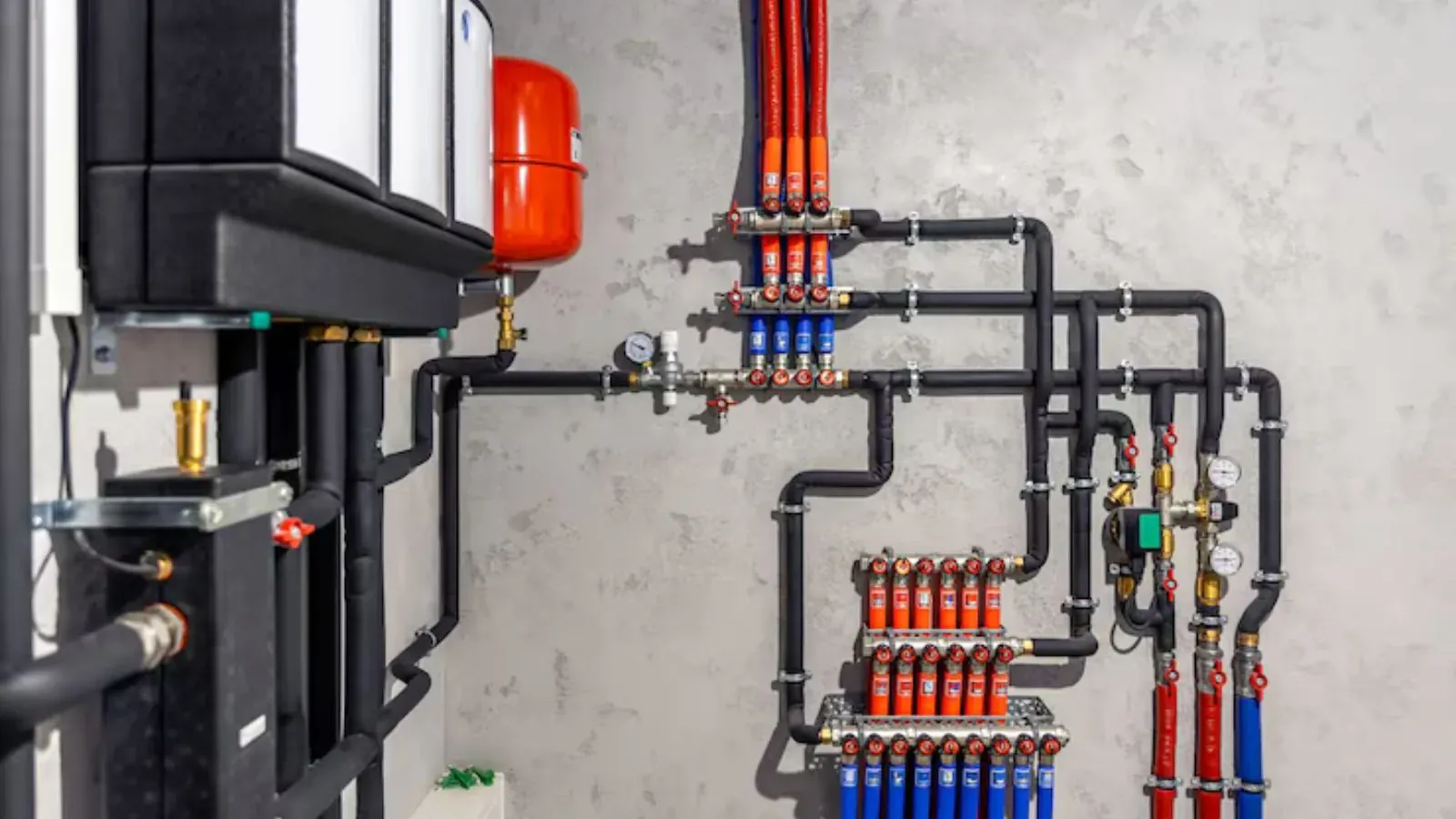
What the expansion tank does
Water expands when it is heated. In a closed heating loop, that extra volume has nowhere to go unless the system has a cushion. The expansion tank provides it. Inside a typical tank, a rubber diaphragm or bladder separates the water from a charge of air. As the water heats and expands, it pushes into the tank and compresses the air. As it cools, the air pushes it back.
If the air charge is lost or the diaphragm tears, the tank fills with water and stops cushioning. The pressure in the loop then rises sharply each time the boiler fires. The pressure relief valve opens to protect the system, and you see a drip, or a puddle under the valve discharge pipe.
A failed expansion tank is a small part and a straightforward repair. A relief valve that keeps opening is a warning, not a nuisance.
Signs of a failing expansion tank
These symptoms often point to the tank.
| Sign | What it suggests | Next step |
|---|---|---|
| Pressure rises quickly when the boiler fires | Tank has lost its air cushion | Check the tank, call a plumber. |
| Relief valve drips or discharges | Pressure exceeded the limit | Shut down the boiler and call. |
| Tank is heavy and full of water | Waterlogged tank | Replace the tank. |
| Water leaks from the tank | Diaphragm or shell has failed | Replace the tank. |
| Air valve on the tank leaks water | Diaphragm has torn | Replace the tank. |
| Frequent need to add water to the system | Possible leak elsewhere | Find the leak. |
A safe check before you call
You can learn a lot in a minute without opening anything.
- Read the pressure gaugeNote the pressure cold and again when the boiler is heating.
- Tap the tankA properly working tank sounds hollow at the top and solid at the bottom. A full tank sounds solid all over.
- Look for dripsCheck the air valve, the tank seams and the relief valve discharge pipe.
- Do not press the air valveWater spraying out means the diaphragm has failed.
- Shut down if pressure is highTurn the boiler off and call.
Local note: when the call goes to the city and when it goes to you
A heating loop is a closed system inside your house, so a boiler problem is yours to fix. If you see water around the boiler and cannot tell where it comes from, the city can help rule out a water main issue. Call Utility Maintenance at 651-450-4309 during business hours, or Dakota County Dispatch at 651-322-2323 after hours. They handle the street side.
Hard water, listed by the city at 20 to 22 grains, is mostly a fill-water issue. Frequent refilling of a leaky loop brings in new minerals each time. Fixing the leak keeps the system cleaner.
What the repair involves
The plumber shuts off and drains part of the system, removes the old tank, installs a new one and sets its air charge to match the system pressure, usually a bit above the fill pressure. The system is refilled, air is purged and pressure is tested.
A good plumber also checks the relief valve and the fill valve. A weeping relief valve may have been damaged by repeated high-pressure events, and a stuck fill valve can overpressurize a loop. Replacing them at the same visit avoids a second call. See boiler repair for the full range of heating work.
Annual service is the best prevention. A technician checks tank charge, relief valve operation, pump and burner. In older homes in West St. Paul and Mendota Heights, we often find expansion tanks that have never been replaced.
Cost factors
We give a clear price before work starts. The price depends on the tank size, how easy it is to reach, whether the system must be drained, and whether other parts need work.
A tank mounted high on a wall or in a tight closet takes longer to replace than one at floor level. A tank that has been in place for many years may have corroded fittings that need replacement.
Call for your real number.
Setting the right air charge
The air charge in the tank must match the pressure of the system when it is cold. If the fill pressure is 12 psi, the tank is typically charged to the same figure with the water side drained. A charge that is too low lets the tank fill with water too easily. A charge that is too high leaves no room for expansion.
A plumber checks the charge with a tire gauge on the air valve, with the tank isolated and drained of pressure. That is why it is not a quick check on a live system. Write the correct pressure on the tank with a marker so the next person knows.
Other parts that cause the same symptoms
Pressure swings and a dripping relief valve do not always mean the expansion tank. A fill valve that sticks open feeds new water into the loop and raises pressure. A relief valve that is worn can weep at normal pressure. A pressure gauge that is stuck can mislead you completely.
A good technician checks each in turn. They read the gauge against a second gauge, cycle the fill valve, and test the relief valve. If the tank passes and the pressure still climbs, the cause is elsewhere. Do not replace parts in a guessing game, because each wrong swap costs a visit.
Keep a note of the date of each repair and the pressure readings. A short history helps the next technician and shows whether a fix has held.
Guidelines worth knowing
Follow the boiler maker's guidelines for pressure and tank sizing, and treat the Minnesota Plumbing Code (Minnesota Rules chapter 4714, based on the Uniform Plumbing Code, UPC) as the floor for safety valves and discharge piping.
Questions about boiler expansion tank repair
Often ten to twenty years, depending on conditions and water quality.
It means pressure is exceeding the safe limit. Shut the boiler down and call.
A tank with a working diaphragm can be recharged with an air pump, but the system must be depressurized first. A plumber should do it.
The city. In Inver Grove Heights, call 651-450-4309 during business hours or 651-322-2323 after hours.
If it has opened repeatedly, yes. It may no longer seal.
Need help with this in Inver Grove Heights?
Call the 24/7 line and describe what is happening.
Call (651) 946-0134