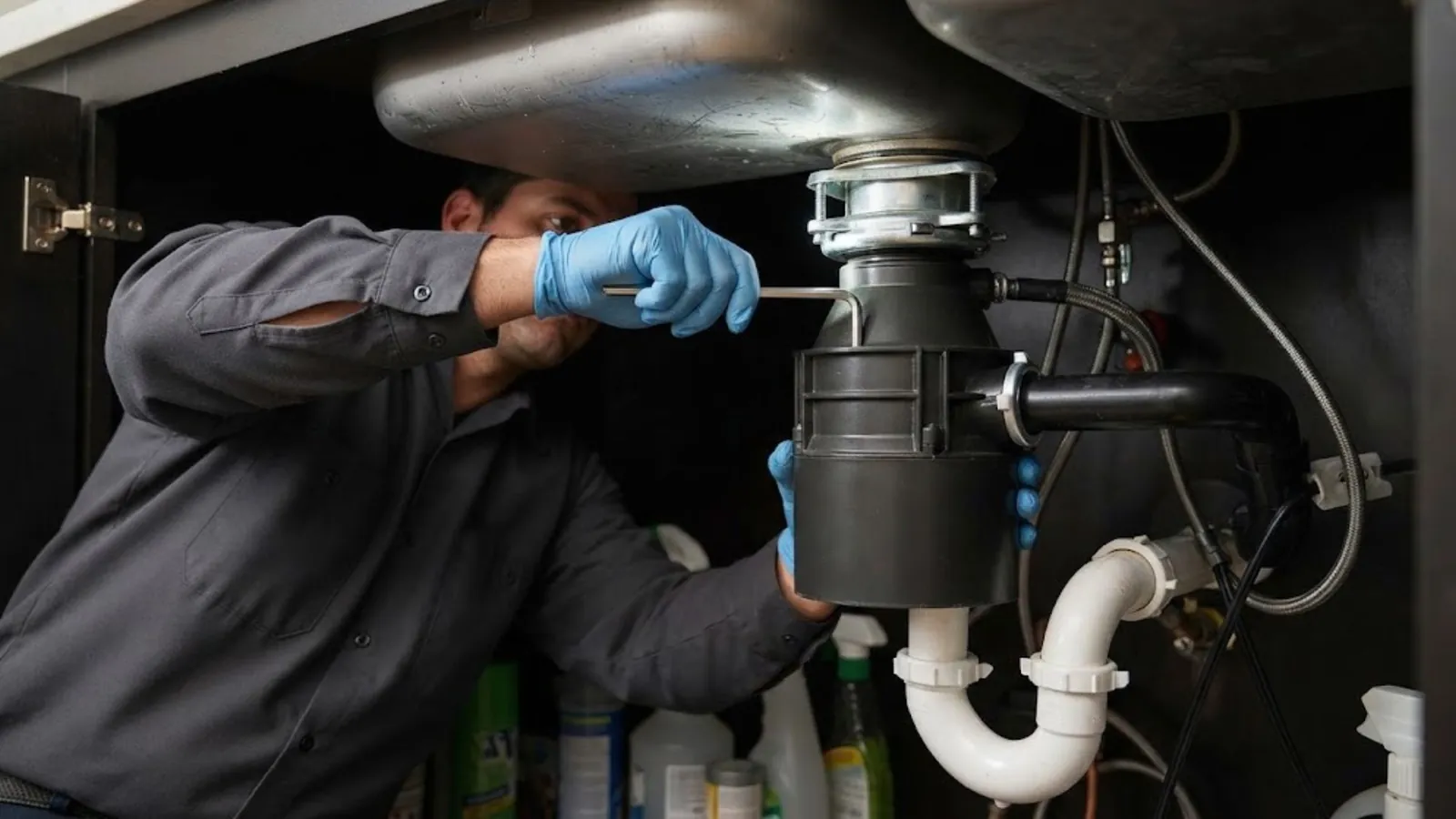
Before you start
A disposal sits under the kitchen sink and connects to three things: the sink drain flange above, the drain trap below and sometimes the dishwasher hose on the side. It also connects to power, either hardwired or through a plug at an under-sink outlet. Look at what you have before you buy the replacement.
Match the mounting system. Most disposals use a three-bolt mount or a quick-lock ring, and a new unit with a different mount may need the old sink flange swapped. Check the horsepower, the size of the unit, and whether the cord comes attached. Take a photo of the old setup before you disconnect anything.
Turn off the power at the breaker, not just the wall switch. Confirm the circuit is dead before you touch any wire.
The basic steps
These are the steps for replacing an existing disposal with a similar one.
- Disconnect and remove the old unitLoosen the drain pipes and dishwasher hose, then twist the unit off its mount.
- Check the sink flangeIf the putty seal is old or the flange leaks, remove the mount and reinstall the flange with fresh plumber's putty.
- Prepare the new unitKnock out the dishwasher plug if you have a dishwasher, and wire the cord if needed.
- Mount the new unitAttach it to the mounting ring and lock it into place.
- Reconnect the plumbingConnect the discharge pipe, the trap and the dishwasher hose.
- TestRestore power, run water and check every joint for leaks while the unit runs.
The knockout plug is the classic mistake. If it is left in place, the dishwasher cannot drain through the disposal and backs up into the dishwasher tub.
Common mistakes and how to avoid them
Most DIY problems fall into a few patterns.
| Mistake | What happens | How to avoid it |
|---|---|---|
| Not removing the dishwasher knockout | Dishwasher will not drain | Remove the plug with a screwdriver and hammer, then fish out the piece. |
| Too little plumber's putty | Leak around the flange | Roll a rope of putty and press the flange firmly. |
| Overtightened mounting bolts | Cracked flange or uneven seat | Tighten each bolt a little at a time. |
| Reversed trap pieces | Slow drain or leak | Test fit before tightening. |
| Wrong wiring | Shock hazard or tripped breaker | Match black, white and ground and use the cover. |
| Skipping the leak test | Water damage under the sink | Run water and check with a dry paper towel. |
Local note: permits and who to ask in Inver Grove Heights
The City of Inver Grove Heights Permits and Inspections office is at 651-450-2550. A like-for-like disposal swap is a small job, but if you add a new circuit or change the drain layout, ask the office what is required.
The city also lists local water at 20 to 22 grains of hardness. Hard water leaves mineral buildup under the grinding chamber and in the trap, so a disposal here benefits from regular cold-water flushing and occasional cleaning. A disposal that smells or runs slowly often has scale, not just food waste.
When to call a plumber
Hire out the job if the cabinet floor is soft or stained, which suggests a long-term leak. Hire it out if the drain has no proper trap, if the sink is badly corroded or if you are adding a disposal where none existed and the electrical is not in place.
Call for help if the new unit leaks from the bottom or side after you have tightened everything. That usually means a defective unit, not a poor install. Our garbage disposal repair page describes what we do for leaks, jams and replacements.
A plumber can also handle a related job at the same time, such as replacing a worn shutoff valve under the sink. See plumbing installation for what else we install.
Keeping the new disposal healthy
Run cold water before, during and after use. Grind small amounts at a time. Avoid grease, fibrous scraps such as celery and corn husks, large bones and starchy buildups such as rice and pasta. Grind a few ice cubes and a bit of citrus now and then to clean the chamber.
If you live in Eagan or West St. Paul, the same care applies. Older homes with cast iron drains and long kitchen runs are especially sensitive to grease. A disposal does not make grease disappear. It sends it down the line.
If your sink backs up even though the disposal runs, the clog is beyond it. That is a drain cleaning job.
Tools and parts to have on hand
Gather a flat screwdriver, an adjustable wrench, pliers, plumber's putty, a bucket, a flashlight and a hex key. Have a new discharge elbow and a new dishwasher hose clamp ready, because old rubber and clamps often fail when disturbed. A new power cord kit is needed if the unit does not come with one.
Work with the water shutoffs closed, the breaker off, and a towel in the cabinet. Keep the old unit's mounting ring and gaskets until the new one is working, in case you need to compare.
Wiring: hardwired or plug-in
Some disposals are hardwired into a junction box under the sink. Others plug into an outlet in the cabinet, controlled by a wall switch. If your old unit was hardwired and the new one comes with a cord, you can usually use the cord kit and a strain relief connector, matching black to black, white to white and the ground wire to the green screw.
If you are not comfortable working with wiring, hire an electrician or a plumber for that step. A disposal that trips a breaker or hums without turning may have a wiring fault, and a loose connection is a fire risk.
Guidelines worth knowing
Follow the maker's installation guidelines for your model, and know that the drain connection should meet the Minnesota Plumbing Code (Minnesota Rules chapter 4714, based on the Uniform Plumbing Code, UPC).
Questions about installing a garbage disposal
Often two to three hours for a swap, longer if the flange or wiring needs work.
For a simple swap, usually not, but confirm with Permits and Inspections at 651-450-2550 if you change wiring or drain layout.
Choose by household use. A larger motor is quieter and jams less.
Many septic owners avoid or limit disposals. Ask your septic service.
Check the flange seal, the mounting ring and the drain connections. A leak from the body means a defective unit.
Need help with this in Inver Grove Heights?
Call the 24/7 line and describe what is happening.
Call (651) 946-0134