How to tell a pipe is frozen
The first sign is usually a faucet that gives a trickle or nothing. If other faucets work and one does not, the freeze is in that branch. If nothing runs, the freeze may be at the main or the service line. Frost on the outside of a pipe, a bulge, or a pipe that is very cold to the touch confirms it.
Common freeze spots are pipes in exterior walls, in unheated garages and crawlspaces, in cabinets against outside walls, under mobile-home skirting and in rooms over cold garages. A cold snap with wind makes them worse.
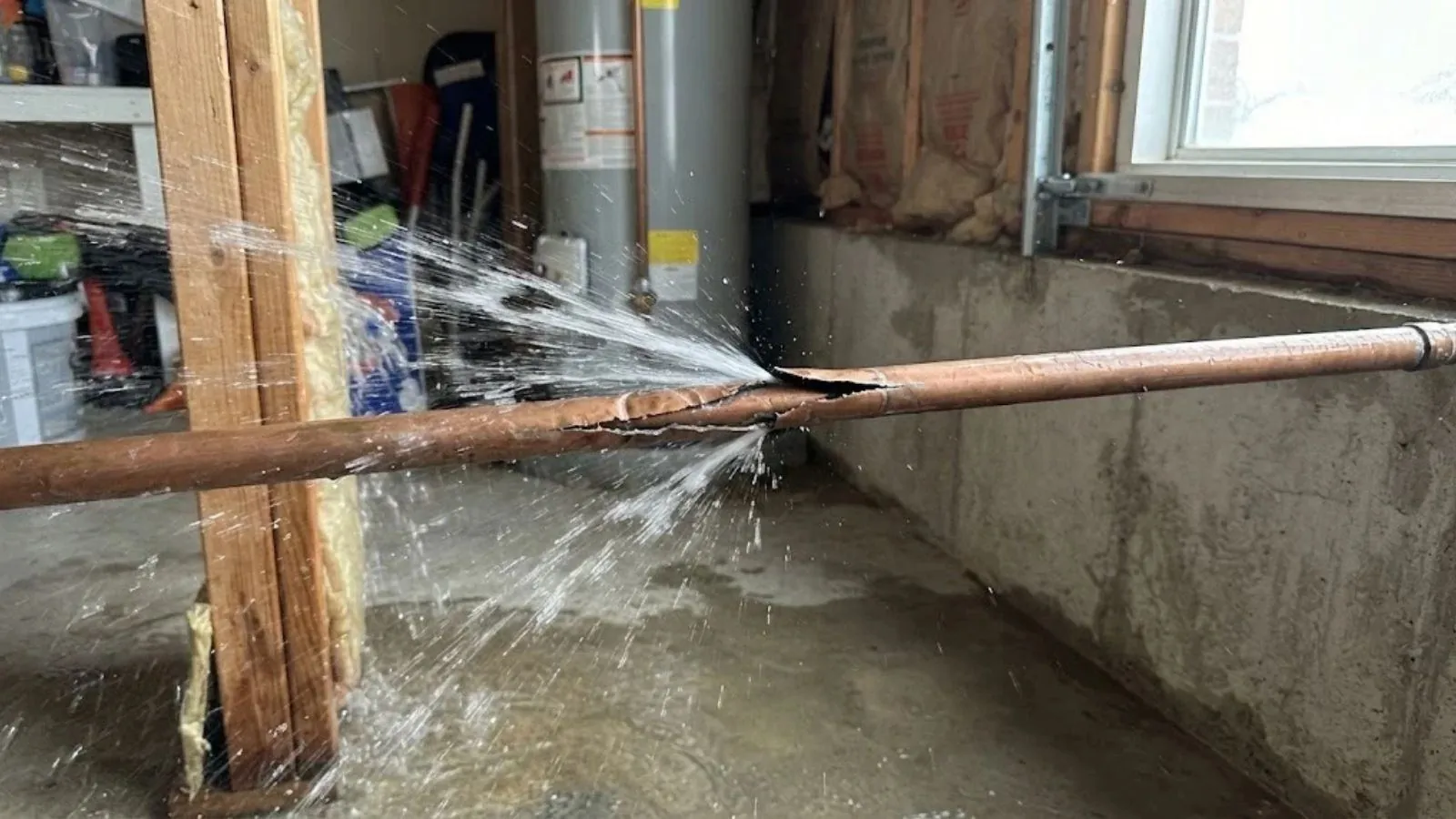
Do not wait. Ice expands, and pressure builds between the ice and a closed faucet. The pipe often splits at the weakest point, and the split shows only when the ice melts.
How to thaw a frozen pipe
Work slowly. The goal is gentle warmth, not heat.
- Open the faucetLeave it open so water and steam can escape as the ice melts.
- Find the frozen sectionFeel along the pipe. The coldest part is usually the freeze.
- Apply gentle heatUse a hair dryer, a heating pad or warm towels. Start near the faucet and move toward the blockage.
- Keep watchingCheck for leaks as water begins to flow.
- Call a plumber if it does not thawOr if you cannot reach the frozen section.
Never use an open flame, a torch or a kerosene heater on a pipe. It can start a fire or damage the pipe.
What to do and what to avoid
A quick reference.
| Do | Do not |
|---|---|
| Shut off the main if you see a split | Use a propane torch. |
| Open the faucet to relieve pressure | Leave the faucet closed while thawing. |
| Warm the area with a space heater placed safely | Leave a heater unattended. |
| Call a plumber for a pipe inside a wall | Cut into walls blindly. |
| Photograph any damage for insurance | Delay calling your insurer. |
Local note: where to call when water is the city's problem
If no water is coming into the house and neighbors have the same problem, call the city. Utility Maintenance is at 651-450-4309 from 7 a.m. to 3:30 p.m. for water main issues, and Dakota County Dispatch is at 651-322-2323 after hours. A frozen or broken main is the city's job.
If only your house has no water, the freeze is probably on your side, in the service line or the house piping. Water in the city comes from six wells in the Jordan aquifer, per the city's 2024 report. That is the source, not the cause. The cause of a freeze is cold air reaching a pipe.
How to prevent freezes
Most freezes are preventable.
- Keep the heat onSet the thermostat no lower than 55 degrees when you travel.
- Open cabinet doorsLet warm air reach pipes on exterior walls.
- Let a faucet dripA thin stream moves water and relieves pressure on very cold nights.
- Insulate exposed pipeFoam sleeves are cheap and effective.
- Seal air leaksClose gaps where cold air enters near pipes.
- Disconnect hosesDrain outdoor faucets before the first hard freeze.
When a freeze becomes a burst
If you see water spraying or a stain spreading on a ceiling, shut off the main right away. Open a low faucet to drain the lines and call us. See burst pipe repair for what we do. If you do not know where the water is going, leak detection finds a hidden split.
A pipe that has frozen once may have been weakened, even if it did not split. Ask your plumber to look at it. In older houses, a freeze often reveals a spot that needs rerouting or insulation.
If you live in Eagan or Mendota Heights, we cover both, and our line is open all winter.
Going away in winter
A vacant house is the most dangerous situation for a freeze. If the heat fails while you are gone, no one is there to notice. Set the thermostat no lower than 55 degrees, ask a neighbor to check the house, and consider a smart thermostat or a temperature sensor that alerts your phone.
For a long absence, you can shut off the main and drain the system. Open the faucets, flush the toilets and drain the water heater according to its manual. This is more involved than leaving the heat on, and it is best done with a plumber's guidance.
Signs of a pipe that is about to freeze
Watch for a slow flow from one faucet on a very cold morning, frost on a pipe in a crawlspace, or a cabinet wall that feels icy. These are early warnings. Open the cabinet doors, let the tap drip and add heat to the area before the pipe locks up.
Wind matters as much as the temperature. A gap in the siding or a drafty rim joist can chill a pipe far below the room temperature. Seal gaps with caulk or foam and add insulation before the next cold snap.
After a thaw: check for slow leaks
A pipe that froze and thawed without bursting can still have a small crack that leaks at a drip or a spray when pressure returns. Watch the area for an hour after the water comes back on. Look at the ceiling below, the wall behind and the floor under the pipe.
Check the water meter too. If it moves with everything off, a hidden split may be leaking. Call for leak detection before the damage spreads.
Questions about frozen pipes
Sudden and accidental bursts are often covered. Damage from neglect may not be. Ask your insurer.
There is no fixed time. The risk is highest as it thaws and pressure changes.
If you see a split or leak, yes. If not, open the faucet and thaw it slowly.
The city. Call 651-450-4309 by day or 651-322-2323 after hours.
Only if it is placed safely and attended. Keep it away from anything that burns.
Need help with this in Inver Grove Heights?
Call the 24/7 line and describe what is happening.
Call (651) 946-0134